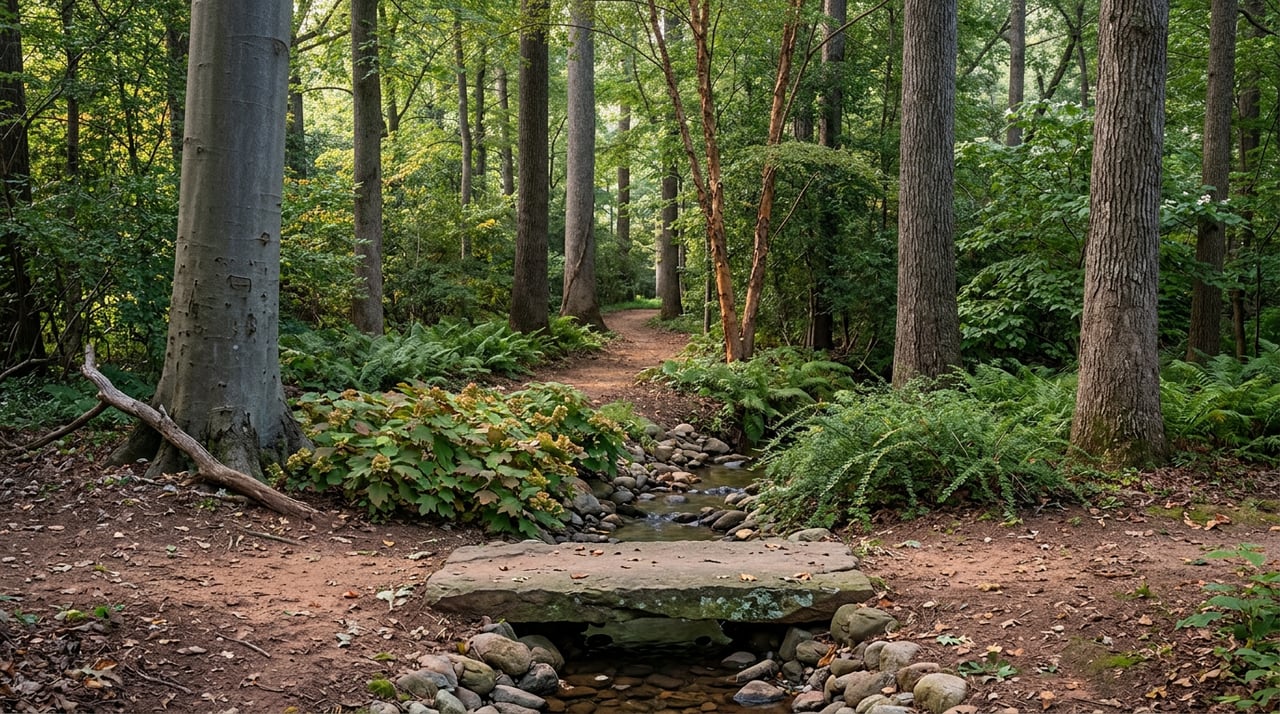
For nearly seventy years, Lucinda Bunnen let her dogs off the leash on Randall Mill Road. She had the room for it. Starting in the late 1950s, when she and her husband Bob commissioned architect Cecil Alexander to build a Frank Lloyd Wright-inspired home on five wooded acres, Bunnen spent the next five decades quietly buying up the land around her, parcel by parcel, until the property reached roughly 30 acres of contiguous forest. Around 2000, she cut two miles of trail through it, not for visitors, but so she and her dogs could walk it properly. She died in 2022 at 92, known in Atlanta as the godmother of Southern photography and one of the people who helped build the High Museum's photography collection. After her death, the estate went up for sale. Instead of being carved into new lots, it was bought in 2024 by the national nonprofit The Conservation Fund, which held the land until the City of Atlanta was ready to buy it outright. That closing happened on June 30, 2026.
Here is the part that changes how you should think about it: this is not becoming a park the way Buckhead usually means that word. And the reason is not intention. It is math.
The Forest Nobody Was Supposed to Find
Mature woodland this size almost never survives development pressure in Buckhead, where large wooded lots routinely get cleared for single estates before the closing paperwork is even dry. Neighborhood association president Sally Riker put it plainly when the sale was announced: in her part of town, homes sell, the trees get cut down, and a house goes up in their place. That is the pattern the Bunnen property broke. At roughly 30 acres, the site is larger than Centennial Olympic Park and Woodruff Park combined, sitting just east of I-75 and south of I-285 in a stretch of the city that conservation officials describe as under tremendous development pressure. It was, by The Conservation Fund's own accounting, the only property of its size in that part of Buckhead that still had mature tree canopy and no protection.
The final purchase price the city paid was $15 million, split evenly between the city's Tree Trust Fund and private donations.
What the Funding Source Actually Locks In
That funding split is the detail worth sitting with, because it is doing more work than a line item usually does.
The Tree Trust Fund is not general city money. It is built from recompense fees, the payments Atlanta property owners make under the city's Tree Protection Ordinance when they remove a healthy tree and cannot replant it on their own lot. A citizen-led Tree Conservation Commission oversees the fund, and by rule, that money can only go toward planting and maintaining trees on public land, buying forested land for permanent conservation, or funding education programs. It cannot pay for a ball field. It cannot pay for a playground. It cannot pay for pickleball courts.
Because half the purchase came directly from that fund, District 8 City Council member Mary Norwood has been explicit that the outcome is not a design choice the city could reverse later. It is a legal condition baked into how the land was bought.
"It was bought with Tree Trust Fund money, and you cannot take out trees when you use Tree Trust Fund, so it was very deliberate that this is not going to be something that we all of a sudden come up with these different activities."
Norwood has pointed the parks department toward a specific model for what comes next: Cascade Springs Nature Preserve, a wooded tract on Atlanta's southwest side that the city has managed for decades. Its appeal is restraint. Walking trails through hardwood forest, natural springs, and a secured perimeter that keeps the land intact rather than turning it into programmed park space. Norwood has told the parks department to replicate that approach directly, including the restricted, controlled entry points Cascade Springs uses, without charging admission.
Not Buckhead's Other 30 Acres
If the number 30 acres sounds familiar, it should. Blue Heron Nature Preserve, tucked into North Buckhead off Roswell Road, is also described as 30 acres and also touches a branch of the Nancy Creek watershed. It would be easy to assume the Bunnen forest is simply a second location of the same idea. It is not, and the difference tells you something about how the city is treating each piece of land.
| Bunnen Preserve (Randall Mill Rd) | Blue Heron Nature Preserve (Roswell Rd) | |
|---|---|---|
| Funding source | City Tree Trust Fund + private donations | City-managed park land |
| Legal restriction on development | Trees cannot be removed, by rule of the funding source | No comparable restriction |
| On-site programming | None planned by design | Community garden, turtle sanctuary, Atlanta Audubon Society and Amphibian Foundation headquarters |
| Trail access | Existing 2-mile trail network, not yet open to the public | Open now, 3-mile Blueway Trail |
| Management model | Modeled on Cascade Springs Nature Preserve | Established preserve with active nonprofit partners |
Blue Heron has built a full public program around its acreage, gardens, wildlife rehabilitation groups, an organized trail network open today. The Bunnen property is heading the opposite direction on purpose. It is the difference between a preserve designed to host activity and one designed to be left alone. For a neighborhood that already has one well-loved, well-programmed 30-acre greenspace, having a second one that behaves nothing like the first is not redundant. It is the point.
What's Actually There Now, and When You Can Walk It
None of this is open yet. That is worth saying directly, because the story reads like an announcement of a new amenity, and it is not quite that, not this year.
What exists on the ground right now:
- A 7,000-square-foot mid-century home designed by Cecil Alexander, the architect also known for Atlanta-Fulton County Stadium, sitting on the original five-acre parcel
- Roughly two miles of trail that Bunnen built herself, cut for dog walking rather than public traffic
- A cascading stretch of Little Nancy Creek running through the property
- Canopy coverage that conservation officials have called close to complete for a site this size
Norwood has said trails could open to the public as early as next year, with the city first focused on securing the property's perimeter the way it has at Cascade Springs. Longer term, the plan is to bring artists in residence into Bunnen's former home for exhibitions, a use that fits both her legacy and the quiet, uncommercial character the funding structure already guarantees. None of that is scheduled yet. For now, the forest belongs to the city, the trees are protected by the terms of the purchase itself, and the gate stays closed a little while longer.
That is the actual shift here, not a new amenity opening this fall, but a guarantee, written into how the land was paid for, that 30 acres a few minutes from some of Buckhead's busiest development corridors will stay exactly as dense, exactly as quiet, and exactly as wooded as the woman who built the trails left them.
If you already call Buckhead home, that is worth knowing before the ribbon-cutting, not after. And if the idea of a neighborhood where legacy, land, and architecture still shape the map the way Cecil Alexander and Lucinda Bunnen once did appeals to you, Debra Johnston has spent more than two decades reading exactly that kind of Buckhead. Let's Connect.